Wide uses the full column for everything, text, diagrams, code, and exercises. Narrow keeps the standard reading width.
Text size
Scales the body text. Headings and code blocks keep their size.
In this section
▾
GRC for Security Professionals: Course Orientation
Module 0 · Free
GRC FOR SECURITY PROFESSIONALS · MODULE 00
GRC that reduces risk and survives the audit. Not theater.
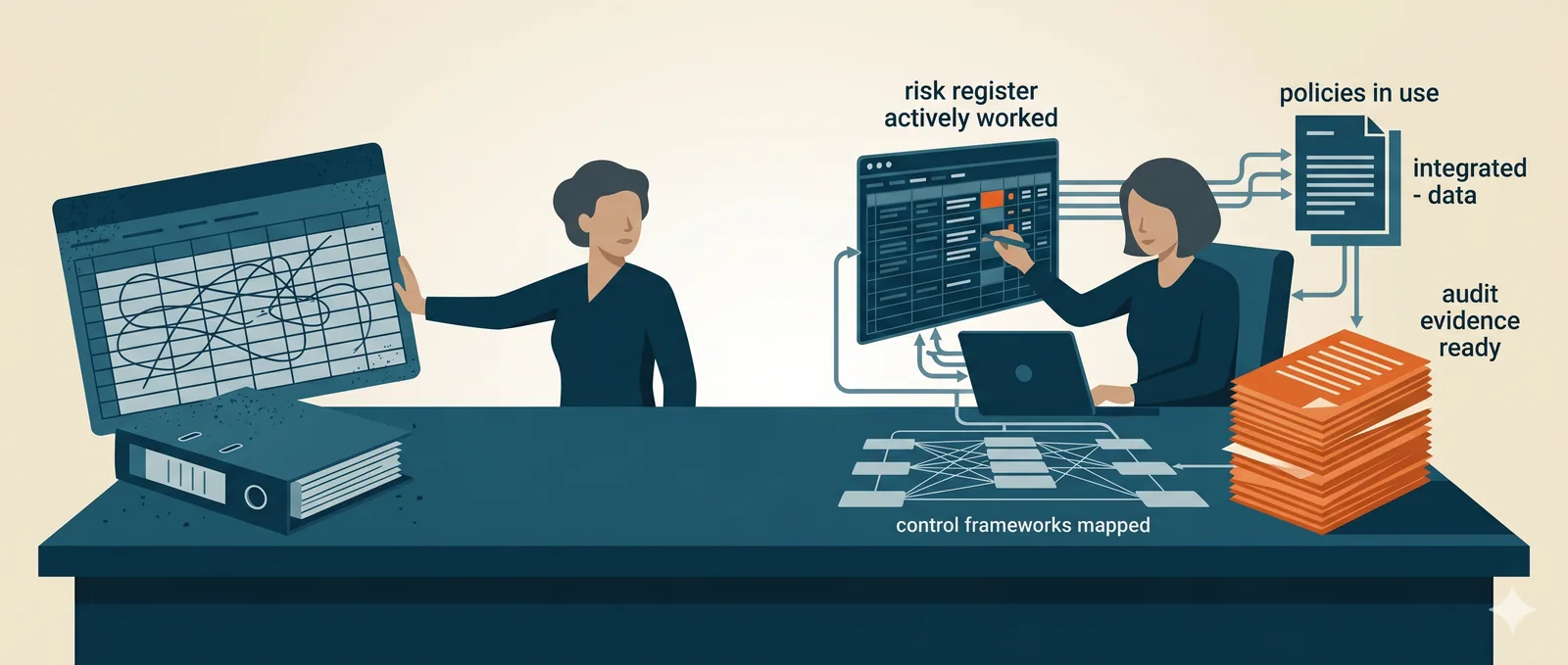
The usual GRC is a 400-control spreadsheet, a template pack full of placeholders, and policies in a folder nobody opens, none of which reduces any risk. This course teaches you to build a working program instead: a risk register you actually work, policies people follow, controls mapped to the frameworks that matter, ISO 27001, NIST CSF, SOC 2, GDPR, and CMMC, and audit evidence produced as a byproduct rather than a yearly fire drill. You leave with the program framework, not a binder. This module shows you what you'll build, the program you're building toward, and how the course gets you there.
17 modules
across 4 phases
5 frameworks
ISO, NIST, SOC 2, GDPR, CMMC
Audit-ready
evidence that holds up
No prerequisites
every concept built up
Why this course exists
Most GRC is theater. A consultant hands over a spreadsheet with four hundred controls, a policy pack where every document still says insert organization name, and an invoice with a lot of zeros. Six months later the spreadsheet is stale, the policies sit in a folder nobody has opened, and the next audit triggers the same scramble as the last one. None of it lowered a single risk. It produced documents, and documents are not a program.
A working GRC program is an operating discipline, not a deliverable. Risk is assessed and tracked in a register you actually maintain, policies are written to be followed and are followed, controls are mapped to the frameworks the business is measured against, and evidence accumulates as a byproduct of running the program so an audit becomes a report you can already produce rather than a fire drill. This course teaches you to build exactly that, across ISO 27001, NIST CSF, SOC 2, GDPR, and CMMC, so governance reduces risk, compliance is provable, and you are never again the person staring at a 400-row spreadsheet the week before an audit.
What you will be able to do
This course is built around the program you can run at the end, not the documents you can hand over. Every module builds one working part of it.
Build a policy framework that is used
Write policies that fit your organization and that people actually follow, not a template pack full of placeholders.
Run a real risk program
Assess risk with a defensible methodology, treat it, and monitor and report it in a register you keep current.
Implement the frameworks
Stand up ISO 27001, NIST CSF, SOC 2, GDPR, and CMMC, and map one set of controls across all of them.
Change behavior and pass audits
Run security awareness that changes behavior, and manage audits as a process rather than a yearly panic.
Lead and report GRC
Report to leadership and the board, communicate risk in their language, and manage regulatory change as it comes.
Build and run the function
Stand up and operate the GRC function itself, and handle sector-specific governance and emerging requirements.
You also leave with things you keep: a working risk register, policy templates fitted to a real organization, control mappings across the five frameworks, and the audit evidence the program produces, a complete GRC program framework rather than a binder of shelfware.
The program you will build
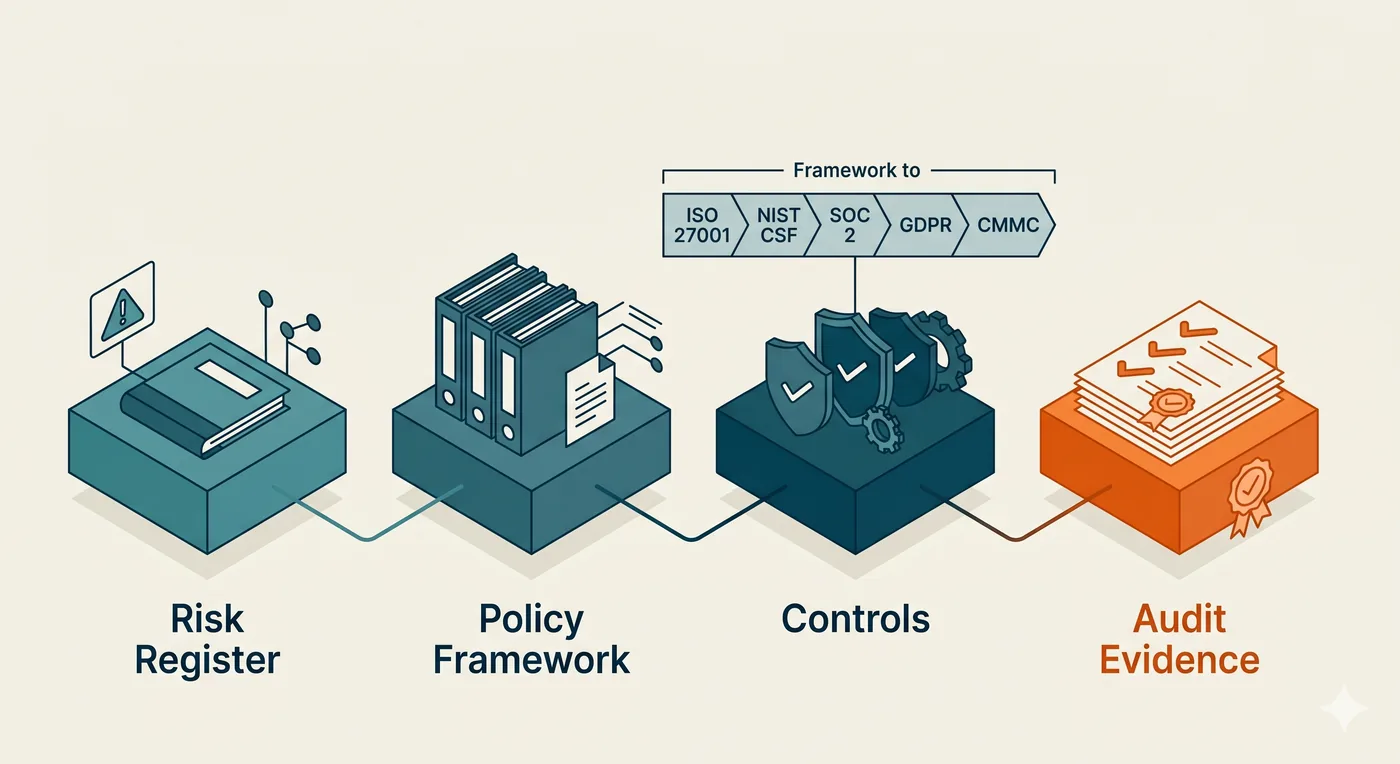
A working GRC program is a connected system, not a stack of documents. Risk goes into a register that drives a policy framework; the policies set controls; the controls map to the frameworks the organization is measured against, ISO 27001, NIST CSF, SOC 2, GDPR, and CMMC; and running all of it produces audit evidence as output rather than as a last-minute scramble. Each stage feeds the next, so the program stays current and an audit becomes something you can answer from what you already have. This course builds every stage of it.
You build it for a real organization rather than against a lab, because GRC is judgment applied to a business, not commands run against a tenant. The discipline is what carries: risk-driven decisions, policies people follow, one control set mapped across many frameworks, and evidence produced as you operate are how governance works anywhere, for any framework and any sector. The five frameworks here are the implementation; running a program that reduces risk and proves it is the skill.
How the course is built
Seventeen modules move through four phases. You ground the foundations and the policy framework, build the risk program, implement the five major frameworks, then run the governance operations, awareness, audit, leadership, and the function itself, that keep it alive.
What you need and who this is for
There are no prerequisites, and every concept is explained the first time it appears. This course is for anyone who owns governance, risk, or compliance without a playbook for it: security practitioners handed compliance on top of the day job, GRC and risk professionals who want a program rather than a spreadsheet, security leads accountable for an audit, and founders or engineers staring down their first SOC 2 or ISO 27001.
Transferable governance discipline
Risk-driven decisions, one control set mapped across frameworks, and evidence as a byproduct work for any framework and any sector. The five here are the implementation; the program is the skill.
Built for a real organization
There is no lab to spin up. You build the program against a real business context, because GRC is judgment applied to an organization, not commands run against a tenant.
How to get the most
Build each artifact for your own organization as you go, the register, the policies, the mappings. Keep the ones that fit, that is how your program framework gets assembled.
Do I already know this material?
Six quick scenarios across the full range of this course, from what GRC really is to reporting risk to a board. Answer them to find out where you sit, and whether this course fits or it will sharpen knowledge you already have.
What is GRC, properly understood?
Producing documents to satisfy auditors.
Governance, risk, and compliance working together as a program that actually reduces and manages risk, with policy, controls, and oversight that change what the organization does, not paperwork for its own sake.
GRC fails when it becomes documents nobody acts on. Done properly it is a working program: governance sets direction, risk management drives priorities, and compliance follows, all changing real behavior rather than filling a binder.
An annual checkbox exercise.
Solely the security team's internal concern.
A company has a thick set of security policies that nobody follows. What is the core problem?
Policy that is not operationalised, communicated, enforced, and tied to real controls is shelfware; a policy only manages risk if it changes behavior and is actually implemented.
A policy is a control only when it is lived: communicated, enforced, and backed by the mechanisms that make people follow it. Unimplemented policy manages nothing, no matter how thorough the document is.
The policies are too short.
There are too few policies.
Policies do not really matter.
You have identified a significant risk. Which is the right way to think about treating it?
Every risk must be eliminated entirely.
Ignore it if mitigation is expensive.
Choose a treatment proportionate to the risk and your risk appetite, mitigate, transfer, avoid, or knowingly accept it, with the decision documented and owned, rather than assuming all risk must be removed.
Risk treatment is a business decision, not a reflex to eliminate. You weigh the risk against appetite and cost and choose to mitigate, transfer, avoid, or formally accept it, with an owner and a record, which is what makes the choice defensible.
Treat every risk identically.
Your organization is certified to a security framework, yet a control that exists on paper failed in practice. What does this most illustrate?
Certification guarantees security.
A control's existence is not its effectiveness; frameworks are a means to manage risk, and controls must be operating effectively, not merely documented, to actually reduce it.
A certificate attests that controls are defined, not that they work every day. The gap between a documented control and an effective one is where real risk lives, which is why operating effectiveness, not paperwork, is the measure.
The framework is worthless.
Certification should be abandoned.
Every audit is a last-minute scramble to gather evidence. What does a mature GRC function do instead?
Hire more people for audit week.
Push the audit date back repeatedly.
Only document controls during the audit itself.
Operate controls continuously and collect evidence as a routine by-product of operations, so audits confirm an ongoing state rather than triggering a one-off scramble.
If controls run continuously and produce evidence as they go, an audit simply samples a state that already exists. The scramble happens only when evidence is created for the auditor instead of generated by everyday operation.
You must report security risk to a non-technical board. What makes the communication effective?
A detailed list of every technical vulnerability.
Telling them everything is fine.
Translating risk into business terms, likelihood, impact, and the decisions and trade-offs leadership owns, so the board can govern risk rather than be shown detail it cannot act on.
A board governs through decisions about risk, not technical detail. Expressing exposure as likelihood, impact, and the choices they own lets them direct and accept risk, which is the whole point of reporting to them.
Avoiding the topic to prevent worry.
This course is for you.
You will build GRC from what it really is through policy, risk assessment and treatment, the major frameworks, audit, and operating the GRC function as a working program.
You have the fundamentals. The value here is the harder half.
You grasp risk and policy, so the payoff is the back half: ISO 27001, NIST CSF, SOC 2, GDPR and CMMC, audit management, board engagement, regulatory change, and building and operating the function.
You handled what GRC really is, operationalised policy, risk treatment, control effectiveness, continuous audit readiness, and board communication, the senior end of the discipline. Take the course to sharpen what you have, close the gaps you did not expect, and turn strong instincts into a working GRC function.
You are a student of this course now, so start by deciding what you want from it. Are you here to build a GRC program from nothing, to pass a specific audit like SOC 2 or ISO 27001, or to replace the GRC theater you inherited with something that actually reduces risk? Name that outcome, then turn it into a study plan: which frameworks and parts of the program matter most to your organization, how much time you will give it each week, and what you want to have built by the time you finish.
The rest of Module 0 sets you up to do exactly that. Work through it to see the problem with how GRC is usually taught, who this course is for, the module map, the prerequisites, and how to get the most from each module. Then begin Module 1.
Stuck on this lesson?
Your question goes straight to the team and we'll reply by email. Sign in to ask.