Wide uses the full column for everything, text, diagrams, code, and exercises. Narrow keeps the standard reading width.
Text size
Scales the body text. Headings and code blocks keep their size.
In this section
▾
Microsoft 365 SOC Engineering: Course Orientation
Module 0
MICROSOFT 365 SOC ENGINEERING · MODULE 00
Build the security operation. Don't just work the queue.
Most SOCs drown in alerts and never mature. This course teaches you to design, run, and improve one that doesn't: detection libraries that surface real attacks, workflows that move an incident from alert to resolution, automation that absorbs the volume, and metrics that prove it works and getting better. This module shows you what you'll build, the operation you'll run it in, and how the course gets you there.
14 modules
across 4 phases
Build & run
the operation, not just the tools
36 CPE
credits on completion
No prerequisites
every concept built up
Why this course exists
A SOC is easy to stand up and hard to run well. Connect the data sources, switch on the vendor rules, and within a week the queue is full, mostly of false positives. Analysts triage the loudest alerts, the quiet ones age out, and nobody can say whether the operation is catching more this quarter than last. The tooling is rarely the problem. The operating model is: no detection strategy, no investigation standard, no automation to absorb volume, no metric that tells you where you stand.
This course is about the operation, not the product tour. You learn to engineer a SOC that improves on purpose: a detection library mapped to the threats that matter, investigation playbooks that make triage consistent across a team and a shift change, automation that handles the repetitive work, and the metrics that move a SOC up the maturity curve from reactive firefighting to a measured, optimizing operation. The Microsoft stack is how you implement it; running a SOC well is what you learn.
What you will be able to do
This course is built around running an operation, not reciting features. You build the artifacts a working SOC depends on and practice the workflows that hold up when the queue is full and the shift is changing.
Build the detection library
Engineer detections across the four domains a SOC lives in, identity and access, email and collaboration, endpoint and lateral movement, and cloud and SaaS.
Run the triage-to-response workflow
Write investigation playbooks that make triage, escalation, and shift handover consistent across the team, not dependent on who is on shift.
Document and report incidents
Produce incident documentation and reporting that stands up to leadership, auditors, and the post-incident review.
Automate the volume away
Build Sentinel automation and SOAR playbooks that handle the repetitive work so analysts spend their time where judgment is needed.
Measure and mature the SOC
Implement hardening baselines and the performance metrics that move the operation up the maturity curve and prove it to the people funding it.
Add intelligence and Copilot
Stand up a threat-intelligence program that feeds detection, and put Copilot for Security to work across the SOC's daily operations.
You also leave with artifacts you keep and can use immediately: operational playbooks for triage, escalation, and shift handover you can implement this week, detection libraries across all four domains, incident report templates, Sentinel automation, a SOC performance dashboard, and a threat-intelligence program.
The operation you will work in
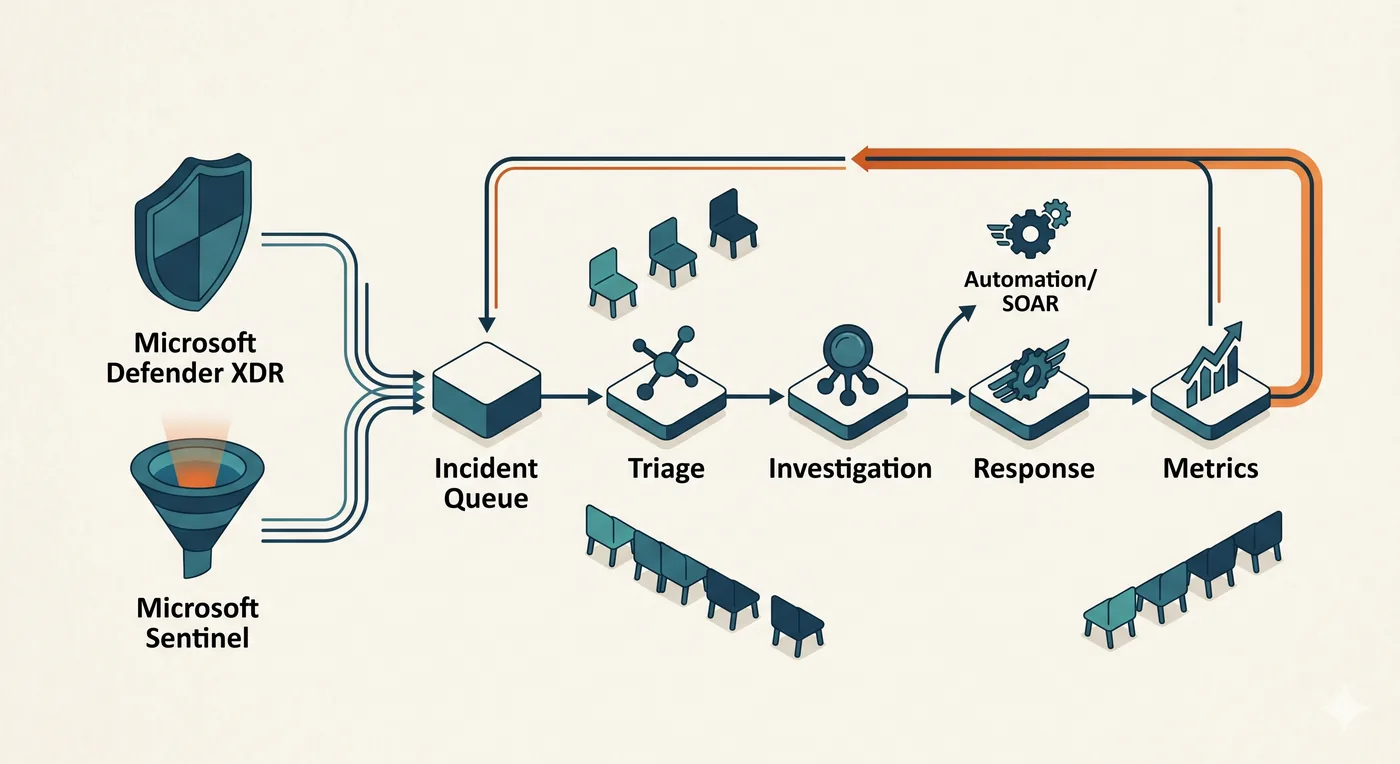
A SOC is not a network diagram, it is a loop. Alerts from Microsoft Defender XDR and Microsoft Sentinel land in a single incident queue, move through triage, investigation, and response, and feed metrics that tell you how the operation is performing and where to improve. Automation sits alongside the analysts, absorbing the repetitive work, and the metrics close the loop back into better detection. This course builds and runs every stage of that loop.
The work runs on a full Microsoft 365 estate, Defender XDR, Sentinel, Entra ID, and the wider security stack, with realistic alert volume so the workflows you design are tested against the noise a real shift faces. The operating model is the transferable part: the queue, the triage and escalation standards, the playbooks, and the metrics are how any modern SOC runs, whatever products sit underneath. Microsoft is the implementation; the discipline travels.
How the course is built
Fourteen modules move through four phases. You set the foundation and a detection methodology, build the detection libraries that feed the queue, turn alerts into investigations and documented response, then operate and mature the whole thing.
What you need and who this is for
There are no prerequisites, and every concept is explained the first time it appears. This course is for anyone who wants to build and run a security operation: analysts moving from clearing a queue to engineering the operation behind it, team leads standing up or maturing a SOC, and engineers who want to own detection, automation, and metrics rather than just consume alerts.
Transferable operating model
The queue, the triage and escalation standards, the playbooks, and the metrics are how any SOC runs. Microsoft is the implementation; the operating model moves with you to any stack.
Helpful, not required
A Defender XDR and Sentinel environment lets you build and run everything live; a free M365 E5 developer tenant gives you one. Without it, you follow every step against prepared evidence.
Usable this week
The playbooks, detection libraries, and metrics you build are production artifacts, not exercises. Many you can take straight into the operation you run today.
Do I already know this material?
Six quick scenarios across the full range of this course, from SOC readiness to measuring performance and safe automation. Answer them to find out where you sit, and whether this course fits or it will sharpen knowledge you already have.
A new SOC is drowning: analysts triage alerts all day but keep missing real incidents. The detections themselves are sound. What is the most likely foundational gap?
Not enough analysts on the team.
The SIEM vendor is the wrong choice.
No triage process or alert prioritisation: without a way to rank and route alerts, volume buries the signal regardless of how good the detections are.
Detection quality cannot save a SOC with no triage discipline. If every alert lands in one undifferentiated queue, the real incident sits next to a thousand benign ones. The fix is process: prioritise, route, and handle by severity.
The detections should be deleted.
Your SOC gets 500 alerts a day, 95% of them false positives. A new analyst suggests building more detections to catch what is being missed. What is the better first move?
Tune and suppress the noisiest false-positive sources first; adding detections to a noisy pipeline makes the real signal harder to find, not easier.
More rules on top of a 95%-false-positive stream multiplies the noise. You earn signal back by tuning and suppressing the worst offenders first, then add coverage onto a pipeline analysts can actually read.
Build the new detections immediately.
Hire more analysts to handle the volume.
Turn off the noisiest detections entirely.
You need a detection for a user who suddenly accesses a large number of SharePoint files they never normally touch. Which design is most robust?
Alert on any access to SharePoint.
Baseline each user's normal access pattern and alert on a significant deviation in volume or scope, since the anomaly is relative to the user, not an absolute number.
A fixed threshold misfires: heavy-access roles trip it constantly while a quiet user's exfiltration slips under it. Baselining per user makes the detection about the deviation from that person's normal, which is what actually signals compromise.
Alert whenever anyone accesses more than 100 files.
Alert only on external sharing.
Two analysts investigate the same alert type and reach different conclusions by different routes. What most directly fixes this?
Assign that alert type to one analyst only.
More general training.
Escalate every instance to a senior analyst.
A documented investigation playbook: the repeatable triage steps, the data to pull, and the decision criteria, so the same alert yields a consistent, defensible outcome.
Inconsistent outcomes come from inconsistent process, not from analyst quality. A playbook encodes the steps and the decision criteria so any analyst reaches the same defensible call, and the SOC can improve the process itself over time.
Leadership wants one metric to show the SOC is improving. An analyst proposes "number of alerts handled." Why is that the wrong metric, and what is better?
It is fine; more alerts handled means more work done.
The SOC should not be measured at all.
Volume handled rewards noise and busywork; better measures are detection coverage and the time to detect and respond to real incidents, which track actual outcomes.
A SOC can handle more alerts by generating more noise, so volume is a vanity metric. Coverage and time-to-detect and time-to-respond measure whether real threats are found and stopped faster, which is the outcome that matters.
Use the number of detections deployed.
You want to automate response in Sentinel. Which action is safest to fully automate with no human approval step?
Disabling any user account that triggers a sign-in alert.
Enriching the alert with context, geolocation, user risk, device, and related events, so the analyst decides faster; enrichment is reversible and low risk, while account disable is high blast radius.
Automation is safest where the action is reversible and low impact. Enrichment only adds context, so a wrong call costs nothing. Disabling accounts, deleting mail, or isolating devices automatically can take down legitimate users, so those keep a human in the loop.
You will build a SOC from foundations and detection methodology through detections across identity, email, endpoint, and cloud, investigation playbooks, automation, and measuring performance.
You have the fundamentals. The value here is the harder half.
You understand how a SOC should run, so the payoff is the back half: investigation playbooks, IR documentation, hardening baselines, Sentinel automation, SOC metrics, a threat-intelligence program, and Copilot.
You handled SOC readiness, robust detection design, the right metrics, and safe automation, the senior end of the discipline. Take the course to sharpen what you have, close the gaps you did not expect, and turn strong instincts into a SOC you can build and measure.
You are a student of this course now, so start by deciding what you want from it. Are you here to stand up a SOC from scratch, to drag an existing one off the reactive treadmill, or to move yourself from clearing alerts to engineering the operation? Name that outcome, then turn it into a study plan: which phases matter most to you, how much time you will give it each week, and what you want to be running by the time you finish.
The rest of Module 0 sets you up for that. Work through it to see what a SOC actually does, the four functions it runs, where most SOCs fail, the maturity curve you are climbing, and the detection-to-response pipeline the whole course builds. Then begin Module 1.
Stuck on this lesson?
Your question goes straight to the team and we'll reply by email. Sign in to ask.