
In this section
Cloud Incident Response: GDPR, SEC, NIS2, HIPAA Notification Requirements
The clocks start before you're ready
Picture this. Your SOC receives an alert at 14:37 on a Thursday: Identity Protection flagged an anomalous token for a finance director's account. You confirm the sign-in is from an IP in a country where your organization has no operations. The account accessed email for two hours before the alert fired. Inbox rules were created. Files were downloaded from SharePoint.
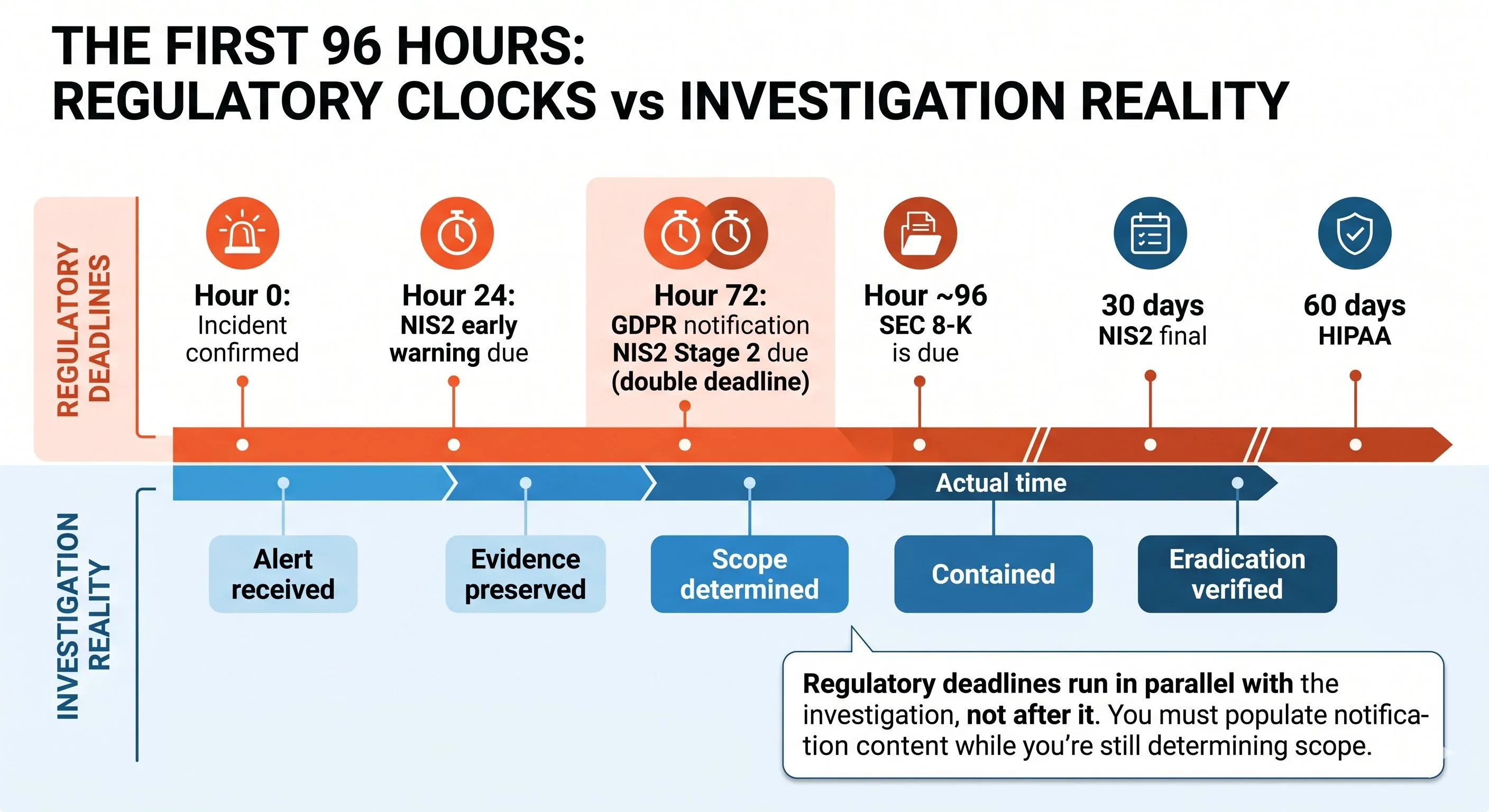
At 14:37, you became "aware" of a breach under GDPR. Your 72-hour clock started. If you're an essential entity under NIS2, your 24-hour early warning clock also started. You haven't even begun the investigation. You don't know how many users are affected, what data was exposed, or whether the attacker is still active. But the regulatory timelines are already running.
This is why regulatory awareness isn't something you hand to legal after containment. It shapes every decision from the moment you confirm a compromise. Whether to preserve evidence before resetting passwords (always). Whether to notify legal immediately (always). Whether your scoping methodology is fast enough to populate a notification while the clock is running (it needs to be). The technical response and the legal response are one response, or you'll fail at both.
GDPR Article 33: 72 hours from awareness
The General Data Protection Regulation applies to any organization that processes personal data of individuals in the European Economic Area, regardless of where the organization is headquartered. An M365 tenant holding email, files, or directory information for EU-based employees or customers is processing personal data under GDPR.
Three elements directly affect IR operations.
The clock starts at awareness, not at investigation completion. The EDPB guidance defines awareness as the moment the controller has a reasonable degree of certainty that a security incident has compromised personal data. Supervisory authorities have consistently held that organizations cannot delay awareness by failing to invest in detection capabilities. If your SOC confirms a compromised account that had access to personal data, you are likely "aware" at that moment. The 72-hour window is already open.
The notification must contain specific information while you're still investigating. Article 33(3) requires the nature of the breach, categories and approximate numbers of individuals affected, likely consequences, and measures taken or proposed. This creates a real tension: the investigation needs time to determine scope, but the notification clock doesn't pause while you investigate. In practice, many organizations submit an initial notification with preliminary findings and supplement it as the investigation progresses. Supervisory authorities accept this approach, but the initial notification itself must be timely.
Failure to notify is a separate infringement. This is the point most organizations underestimate. Even if your technical response was excellent, failing to notify within 72 hours is an independent violation. DLA Piper's January 2026 GDPR Fines and Data Breach Survey reported that average daily breach notifications across the EEA rose 22% in 2025 to 443 per day. The fine ceiling for notification failure: EUR 10 million or 2% of global annual turnover, whichever is higher.
SEC Item 1.05: four business days from materiality
The SEC cybersecurity disclosure rule (effective December 2023) applies to all US public companies registered under the Securities Exchange Act of 1934. Unlike GDPR, the SEC clock doesn't start at breach awareness. It starts when the company determines the incident is material.
SEC FORM 8-K ITEM 1.05
Registrants must disclose material cybersecurity incidents within four business days after determining materiality. The disclosure must include the material aspects of the nature, scope, and timing of the incident and the material impact or reasonably likely material impact on the registrant.
The materiality assessment must happen "without unreasonable delay." Delaying the assessment to avoid triggering the four-day window is itself a compliance risk.
The SEC rule creates a strategic question for the IR team: how fast can you assess materiality? A BEC incident that resulted in a $2 million wire transfer to an attacker-controlled account is clearly material. A compromised service account with no evidence of data access probably isn't. The determination requires both technical findings (what happened, what was accessed, what's the exposure) and business judgment (does this affect financial condition, operations, or investor decisions). The IR team provides the technical facts. Legal and finance make the materiality call.
Since the rule took effect, 41 companies have disclosed cybersecurity incidents via Form 8-K. Fifteen filed under the mandatory Item 1.05 for material incidents. Twenty-six filed under the voluntary Item 8.01 for incidents they determined were not material, indicating that companies are disclosing proactively rather than risking a later determination that they should have filed. The SEC has clarified that ransomware payment doesn't eliminate the obligation: if the incident was material, the 8-K is required regardless of whether the ransom resolved the technical impact.
NIS2 Article 23: the tightest clock in EU regulation
NIS2 applies to essential and important entities across the EU in sectors including energy, transport, banking, health, digital infrastructure, and ICT service management. As of May 2026, the European Commission has referred seven member states to the Court of Justice for failure to transpose the directive. The first NIS2 compliance audit deadline for in-scope entities is June 30, 2026.
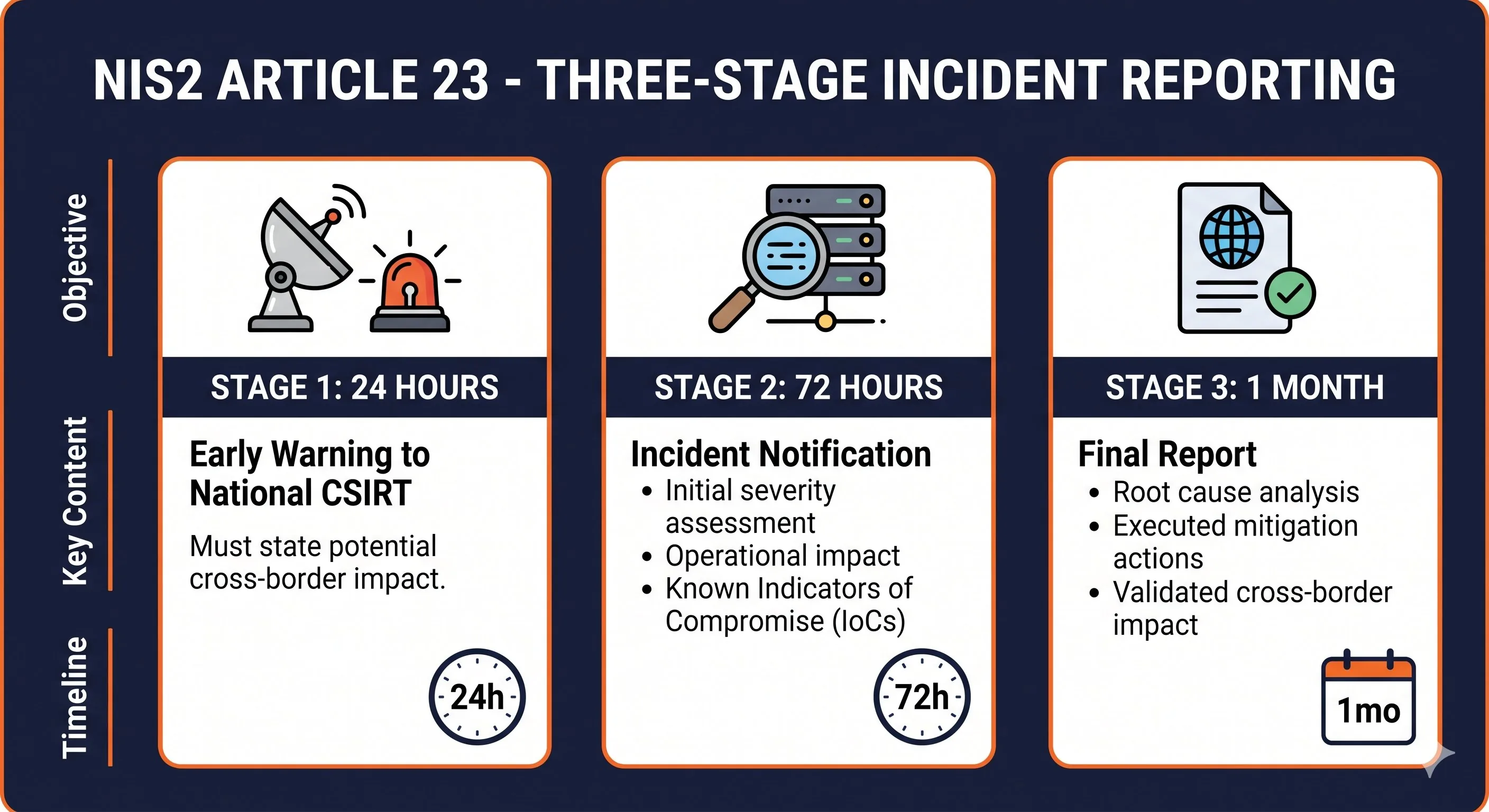
The 24-hour early warning is the tightest initial deadline in EU cybersecurity regulation. It requires a factual notification to the national CSIRT while the incident is still actively unfolding. This is not a full investigation report. It's a signal: something significant happened, here's what we know so far, and here's whether it could affect other member states. The 72-hour Stage 2 notification requires more detail: severity assessment, impact analysis, and indicators of compromise that the CSIRT can use to warn other entities.
For IR teams, NIS2 means the first 24 hours serve dual purposes: you're simultaneously investigating and assembling the early warning. ENISA's 2025 data showed that 68% of significant cybersecurity incidents affecting essential entities went unreported or were reported late under the original NIS Directive. NIS2's tiered reporting and enforcement penalties (up to EUR 10 million or 2% of global turnover for essential entities) are designed to close that gap. Management bodies are personally accountable under Article 20.
HIPAA: 60 days with a compressed operational window
The HIPAA Breach Notification Rule applies to covered entities and business associates in the US healthcare sector. The formal notification deadline is 60 calendar days from breach discovery, more generous than GDPR or NIS2.
HIPAA BREACH NOTIFICATION RULE (45 CFR 164.400-414)
Covered entities must notify affected individuals without unreasonable delay and no later than 60 calendar days after breach discovery. Breaches affecting 500+ individuals require concurrent notification to HHS OCR and prominent media outlets.
The 2025 Security Rule updates add 24-hour access-change notification and 72-hour system restoration objectives, compressing the effective operational window even though the formal deadline remains 60 days.
Don't let the 60-day window create a false sense of comfort. A healthcare provider's M365 tenant compromised via AiTM phishing faces the same containment urgency as any other organization. The 2025 Security Rule operational triggers (24-hour access changes, 72-hour system restoration) mean the technical response must happen within days, not weeks. The 60-day notification window gives you time to determine scope and prepare the notification, not time to delay the investigation.
Breaches affecting 500 or more individuals require notification to HHS, affected individuals, and media outlets in the affected jurisdiction. The HHS Wall of Shame (officially the Breach Portal) publishes every large breach publicly. For healthcare organizations, a breach notification is also a public disclosure.
What overlapping deadlines look like in practice
An M365 incident at a publicly listed EU healthcare company could trigger all four frameworks simultaneously. Here's what the first week looks like:
HOUR     DEADLINE                          WHAT'S REQUIRED
0        Incident confirmed                Legal notified. Evidence preservation begins.
24       NIS2 Stage 1 due                  Early warning to CSIRT: nature, cross-border assessment.
72       GDPR Art 33 due                   Notification to supervisory authority: nature, scope,
                                           approximate numbers, consequences, measures taken.
72       NIS2 Stage 2 due                  Severity assessment, impact analysis, IoCs.
72       HIPAA operational                  Access changes completed. Systems restoration target.
~96      SEC materiality assessed           If material: 4-business-day 8-K filing clock starts.
~120     SEC 8-K Item 1.05 due             Material aspects of nature, scope, timing, impact.
30 days  NIS2 Stage 3 due                  Final report: root cause, mitigation, cross-border.
60 days  HIPAA notification due            Individual notices, HHS, media (if 500+).
Each of these deadlines requires different content, goes to a different authority, and has different consequences for failure. The IR team's investigation provides the raw findings. Legal, compliance, and communications translate those findings into the specific format each regulator requires. Module 8 teaches the complete notification process. The point here is simpler: these obligations exist from hour zero, and they shape what the IR team must prioritize.
The business impact beyond fines
Regulatory penalties are the visible cost. The larger impact is operational. IBM's 2025 Cost of a Data Breach Report found that organizations with formal IR teams save $473,706 per breach on average. The average total cost of a data breach reached $4.88 million in 2024. Organizations that contained a breach in under 200 days saved $1.02 million compared to those that took longer.
Delayed or poorly communicated response amplifies every cost: extended downtime while the investigation drags, customer attrition when the notification arrives late and feels like concealment, litigation from affected individuals who weren't notified promptly, insurance complications when the carrier discovers the response didn't follow the plan, and reputational damage that outlasts the incident itself.
The regulatory frameworks aren't obstacles to effective IR. They're a forcing function for the preparation, speed, and completeness that good IR requires anyway. An organization that can meet GDPR's 72-hour notification deadline has, by definition, built the detection, evidence collection, and scoping capabilities that make the technical response work. The regulations and the technical response point in the same direction.
Section 1.5 puts investigation tools in your hands for the first time.